
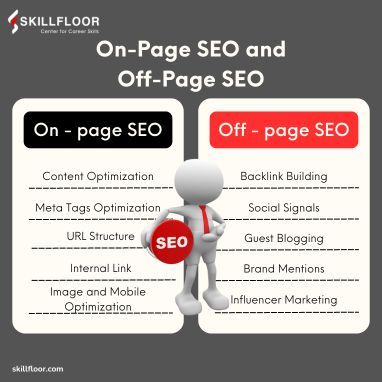
On-Page SEO and Off-Page SEO: What’s the Difference?
Search engine optimisation (SEO) involves many activities, but they can broadly be grouped into two areas: on-page SEO and off-page SEO. On-page SEO focuses on the content and elements of your website. Off-page SEO covers actions taken elsewhere online that can help build your site’s reputation and authority.
Both are important. A well-optimised website may struggle to perform if few trustworthy sources recognise it, while a strong backlink profile cannot make up for pages that are confusing, unhelpful or difficult to use.
What is on-page SEO?
On-page SEO is the work you do on your own website to help search engines understand its pages and help visitors find useful information. It includes both the content itself and the way that content is organised.
Key elements of on-page SEO
- Helpful, relevant content: Create accurate pages that address what your audience wants to know or do. Aim to answer the topic thoroughly rather than repeating phrases simply to attract search traffic.
- Title tags and meta descriptions: Write a clear, descriptive title for each page. Meta descriptions can summarise the page in search results and encourage relevant visitors to click, although they are not a direct ranking factor.
- Headings: Use headings to organise information logically. A clear heading structure makes a page easier to scan for both people and search engines.
- URLs: Keep addresses readable and descriptive where practical. Avoid unnecessary complexity.
- Internal links: Link related pages together using helpful, natural wording. This can make it easier for visitors and search engines to discover your content.
- Images: Use relevant images, compress them to support page speed, and add descriptive alternative text where it helps people using assistive technology.
- Page experience: Make pages easy to use on mobile devices, quick to load and straightforward to navigate. Clear layouts and accessible design benefit visitors as well as your wider SEO efforts.
What is off-page SEO?
Off-page SEO refers to activities outside your website that can influence how people and search engines perceive it. A central part of this is earning links from other websites, but off-page SEO is broader than link building alone.
Key elements of off-page SEO
- Quality backlinks: Links from relevant, trusted websites can help people discover your pages and may contribute to your site’s authority. The value of a link depends on its context and source, not simply on the number of links pointing to your site.
- Digital PR: Useful research, expert commentary or newsworthy stories can earn coverage and links from publications and industry websites.
- Brand mentions: People may talk about your organisation online without linking to it. These mentions can support brand awareness and help establish familiarity, even when they do not pass link value.
- Local visibility: For businesses serving a particular area, accurate business details, local directories and customer reviews can help people find and assess the business.
- Reputation and reviews: Genuine customer feedback can build trust with potential customers. Responding professionally to reviews is also part of good customer service.
Off-page SEO should focus on earning recognition rather than manufacturing it. Buying links, participating in link schemes or creating low-quality content solely to obtain backlinks can put a website at risk of search engine penalties.
On-page SEO vs off-page SEO
The simplest distinction is where the activity takes place:
- On-page SEO: Changes made to your website, such as improving a page, refining its headings or adding useful internal links.
- Off-page SEO: Efforts beyond your website, such as earning editorial coverage, building professional relationships or improving local visibility.
Technical SEO is often treated as a separate area, although it overlaps with on-page work. It includes issues such as crawlability, indexing, site structure and performance. A site needs to be accessible to search engines before its content can perform well.
Which should you prioritise?
For most websites, it makes sense to start by improving the site itself. Make sure important pages are useful, accurate, easy to navigate and accessible on mobile. Check that search engines can crawl and index them, and that related pages are linked sensibly.
Once the foundations are in place, work on building awareness and authority beyond your website. Publish material worth referencing, share expertise with relevant publications and develop genuine relationships within your industry. This gives other people a reason to mention or link to your site.
How to combine both approaches
- Understand your audience: Find out what your potential visitors are searching for and what information would genuinely help them.
- Improve key pages: Make your most important pages clear, comprehensive and easy to use.
- Connect your content: Add relevant internal links so visitors can move naturally between related topics.
- Promote useful resources: Share original guides, data or expert insights with people and organisations likely to find them valuable.
- Measure progress: Track relevant measures, such as organic visits, search visibility, enquiries and the quality of referring websites. Look for meaningful trends rather than relying on a single metric.
Final thoughts
On-page SEO helps make your website relevant, understandable and useful. Off-page SEO helps build its visibility and reputation beyond the site itself. Neither is a substitute for the other: the strongest approach combines sound website foundations with worthwhile content and genuine recognition from others.
7 Benefits of On-Page and Off-Page SEO
- On-page SEO makes content clearer and more useful.
- On-page SEO helps search engines understand your pages.
- On-page SEO improves site navigation and user experience.
- Off-page SEO can build your website’s authority.
- Quality backlinks can bring relevant visitors.
- Off-page SEO increases brand awareness.
- Together, they support stronger search visibility.
7 Drawbacks of On-Page and Off-Page SEO
- On-page SEO can be time-consuming to maintain.
- Off-page SEO often takes time to show results.
- Keyword overuse can make content awkward.
- Technical changes may require specialist skills.
- Quality backlinks are difficult to earn.
- Poor link-building can harm your reputation.
- SEO rankings can change without warning.
On-page SEO makes content clearer and more useful.
One of the main benefits of on-page SEO is that it makes your content clearer and more useful for visitors. By organising information with descriptive headings, writing in plain language and linking to relevant pages, you help readers find what they need more easily. These improvements also help search engines understand the page, making it easier to match your content with relevant searches.
On-page SEO helps search engines understand your pages.
A key benefit of on-page SEO is that it helps search engines understand what each page is about. Clear titles, descriptive headings, relevant content and well-structured internal links provide useful context, making it easier for search engines to match your pages with relevant searches. This can also help visitors quickly see whether a page contains the information they need.
On-page SEO improves site navigation and user experience.
One of the key benefits of on-page SEO is that it can improve site navigation and the overall user experience. Clear headings, logical page layouts and relevant internal links help visitors find the information they need and move easily between related pages. When a website is straightforward to use, people are more likely to stay, explore further and complete useful actions, such as making an enquiry or purchase.
Off-page SEO can build your website’s authority.
One key advantage of off-page SEO is that it can build your website’s authority. When reputable, relevant websites link to or mention your content, they can help strengthen your site’s reputation and make it easier for potential visitors to discover. Combined with strong on-page SEO—such as useful content, clear page structure and a good user experience—this authority can support your site’s visibility in search results and encourage people to trust your business.
Quality backlinks can bring relevant visitors.
Quality backlinks are one of the key benefits of off-page SEO because they can bring relevant visitors directly to your website. When a trusted site links to a useful page, its audience may follow the link to learn more, discover your services or explore your content. These visits are more likely to be valuable when the linking page is closely related to your topic, while strong on-page SEO helps ensure visitors find clear, useful information once they arrive.
Off-page SEO increases brand awareness.
A key benefit of off-page SEO is that it can increase brand awareness by helping your business reach people beyond its own website. Earning mentions, links and coverage from relevant websites, publications and industry voices can introduce your brand to new audiences and strengthen its credibility. When this attention leads visitors to your site, strong on-page SEO helps them find useful, relevant information and understand what your business offers. Together, off-page and on-page SEO can turn wider visibility into a more positive and memorable experience.
Together, they support stronger search visibility.
On-page and off-page SEO work best together to support stronger search visibility. On-page SEO helps search engines understand your website and match its content to relevant searches, while off-page SEO can build your site’s reputation and authority across the web. Combining useful, well-structured pages with genuine recognition from trusted sources gives your website a stronger foundation for being discovered by the right audience.
On-page SEO can be time-consuming to maintain.
One drawback of on-page SEO is that it can be time-consuming to maintain. Content, keywords, links and technical elements may need regular reviews as your website grows, search behaviour changes and search engine guidelines evolve. Keeping pages accurate, useful and well organised takes ongoing effort, particularly for larger websites, so it helps to prioritise updates according to their value to visitors and the business.
Off-page SEO often takes time to show results.
One drawback of off-page SEO is that it can take time to produce noticeable results. Earning quality backlinks, building brand recognition and developing trust with relevant websites rarely happen overnight; they depend on consistent effort and genuine relationships. As a result, improvements in search visibility may take months to appear, and outcomes are not guaranteed. This can make off-page SEO feel less immediate than on-page changes, which are often easier to implement and monitor.
Keyword overuse can make content awkward.
Keyword overuse can make content awkward and difficult to read, undermining the very page experience that on-page SEO is meant to improve. Repeating a target phrase unnaturally may also make a page seem less trustworthy to visitors and search engines. Off-page SEO can contribute to the problem if link-building efforts rely on repetitive, exact-match anchor text. Use keywords and link text naturally, prioritising clarity and usefulness over repetition.
Technical changes may require specialist skills.
One potential drawback of both on-page and off-page SEO is that technical changes may require specialist skills. Tasks such as improving site speed, fixing crawl errors, restructuring URLs or implementing structured data can involve coding or a detailed understanding of how websites work. If these changes are handled incorrectly, they may affect the site’s functionality or visibility, so it can be helpful to seek advice from an experienced SEO or web developer.
Quality backlinks are difficult to earn.
A key drawback of off-page SEO is that quality backlinks can be difficult to earn. Reputable websites are selective about what they link to, so building links often takes time, effort and genuinely useful content. There are no guarantees that outreach or digital PR will lead to coverage, and shortcuts such as buying links can damage a site’s credibility or breach search engine guidelines. While on-page SEO is largely within a website owner’s control, earning valuable links depends partly on the choices of other people and organisations.
Poor link-building can harm your reputation.
Poor link-building can damage your website’s reputation and undermine your wider SEO efforts. Buying links, using spammy directories or taking part in link schemes may make your business appear untrustworthy to both visitors and search engines. Instead, focus on earning relevant links through useful content, genuine relationships and credible coverage.
SEO rankings can change without warning.
One drawback of both on-page and off-page SEO is that rankings can change without warning. Search engines regularly update their systems, while competitors may improve their websites or earn new links, causing your pages to rise or fall in search results. Even well-planned SEO can therefore take time to deliver results and may need ongoing attention. Regularly reviewing performance and focusing on useful content and a good visitor experience can help you adapt, but no ranking position is guaranteed.